
You’ve booked the flights. The chalet is sorted. Now comes the question that trips up almost every first-time winter sports traveller: should I ski or snowboard?
The short answer: skiing has a gentler learning curve in the first couple of days, while snowboarding is harder to pick up but easier to master once it clicks — usually around day three or four. Both are brilliant sports, both are available to rent at similar prices, and both are completely accessible for complete beginners with the right lessons and gear.
This guide covers everything you need to make the decision — learning curve, injury risk, cost, gear, lift access, and how each sport feels on the mountain — so you can walk into your first ski school lesson with confidence.
What Is the Difference Between Skiing and Snowboarding?
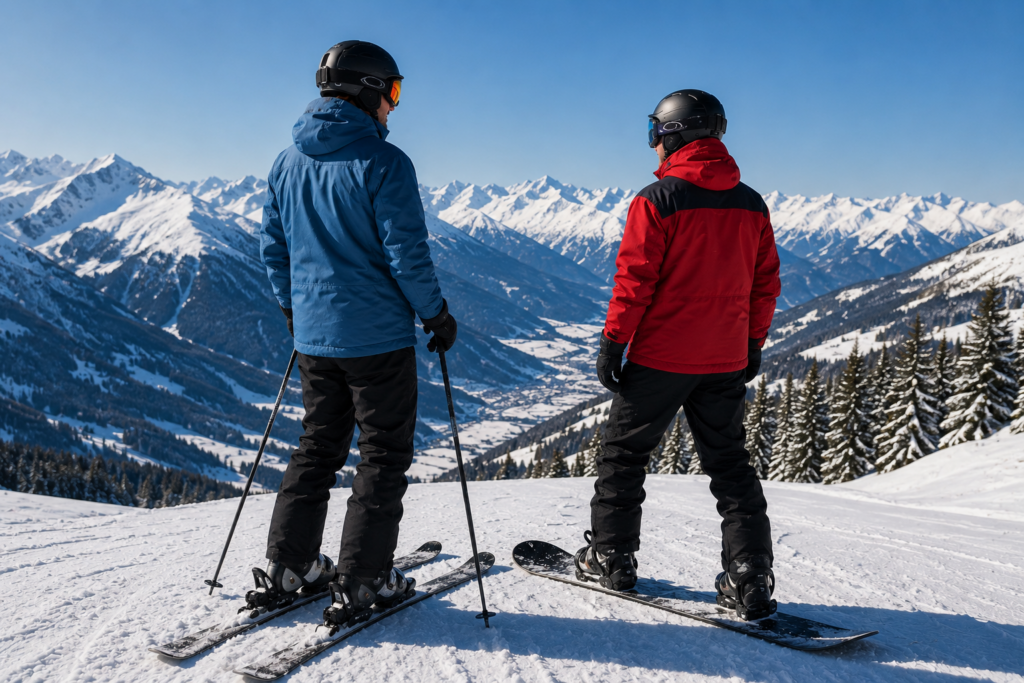
Skiing means two separate skis attached to your boots via bindings, one per foot. You stand facing down the mountain, using poles for balance and direction. Snowboarding means one board strapped to both feet sideways, with your body turned at roughly 45 degrees to the slope. No poles.
Both sports share the same terrain — the same pistes, the same lifts, the same après-ski bar — but they feel entirely different on snow. Skiing gives you more independent control of each leg, which is why balance and basic stopping come quicker at first. Snowboarding ties both feet to a single platform, which makes early falls more frequent but gives you a more unified, flowing feeling once you find your edge.
Most ski resorts across the Alps — in Austria, France, Italy, and Switzerland — welcome both skiers and snowboarders equally. Alpy.com’s partner shops across Europe stock ski hire and snowboard hire for every level, from beginner packages to high-performance race gear.
Skiing vs Snowboarding: Which Is Easier to Learn?
The most honest answer: skiing is easier in the first two days; snowboarding is easier after the first week.
With skiing, your feet are independent and you stand facing forward. Your instinct to point your toes inward to slow down — the “pizza” or wedge position — maps directly to what your body already wants to do. Most beginner skiers are controlling their speed and doing basic turns on a gentle blue run within two to three days.
Snowboarding starts differently. Your feet are locked together and you’re standing sideways — nothing in everyday life prepares you for that. The first day usually involves a lot of falling, getting up, and falling again. Your wrists and coccyx will know about it. But here’s where it flips: once the heel-to-toe edge transition clicks — usually around day three or four — snowboarders progress rapidly. Because there’s only one tool to manage, the mechanics consolidate quickly. By day five, many beginners are comfortably linking turns on blue slopes.
The classic comparison holds: skiing is easier to learn, snowboarding is easier to master.
| Skiing | Snowboarding | |
|---|---|---|
| Day 1–2 | Basic stops and turns feel natural | Frequent falls, steep learning curve |
| Day 3–5 | Blue runs manageable | Linking turns, rapid progression |
| Week 2 | Starting parallel turns | Comfortable on blues, exploring reds |
| Long-term | Harder to truly master | Easier to progress to advanced terrain |
| Physical demand | Leg strength, edge control | Core strength, balance |
Which Is Better for Beginners?
For most complete beginners — especially adults — skiing is the safer first choice. The learning curve is more forgiving, and you’ll feel the reward of controlled descents faster, which keeps motivation high on a week-long ski holiday.
That said, snowboarding is a better fit for some beginners:
- Teenagers and young adults who already skateboard, surf, or wakeboard often take to snowboarding faster — the sideways stance and edge feel are already familiar.
- People with knee concerns sometimes find snowboarding more comfortable, since the fixed binding position reduces rotational strain on the knee joint.
- Those thinking long-term — if you plan to ski every year, many people find they plateau less quickly on a snowboard.
Children under 12 are almost universally better starting with skiing. Their low centre of gravity and natural flexibility make the learning curve much gentler, and most ski schools in the Alps run dedicated children’s classes from age three.
Gear Differences: Ski Equipment vs Snowboard Equipment
The gear for each sport is distinct — and the differences matter more than most beginners expect, both on and off the slopes.
Skiing requires two skis, ski boots, bindings, and poles. Ski boots are rigid and hard-shelled, designed to transfer precise movements to the ski. They’re stiff by design — which is great for edge control on the mountain, but makes walking around the resort noticeably awkward. Carrying two long skis and poles through a busy resort is its own skill.
Snowboarding requires one board, snowboard boots, and bindings — no poles. Snowboard boots are significantly softer and more flexible than ski boots, closer to a sturdy hiking boot in feel. Snowboarders can walk normally between the car park and the shop. Carrying a single board is also considerably easier than managing two skis and a set of poles.
For off-slope comfort, snowboard gear wins. For on-slope precision and early control, ski equipment has the edge — particularly ski boots’ ability to transfer immediate feedback to the ski.
Skiing vs Snowboarding at the Lifts and on Flat Terrain
This is the practical difference most guides skip — and it matters a lot on your first few days.
Skiers can push themselves along flat sections using their poles, skate between runs, and step onto chairlifts and drag lifts without removing any equipment. Getting on and off ski lifts is intuitive almost immediately.
Snowboarders have to unclip their back foot to scoot along flat terrain and to ride button lifts and T-bar lifts. This feels awkward at first and requires a bit of practice. Magic carpet lifts — the flat conveyor belts used on beginner slopes — are the easiest introduction for snowboarders. Chairlifts become comfortable quickly, but drag lifts take more time to master.
Neither is a reason to avoid snowboarding — but it’s worth knowing before your first day, so you’re not caught off guard at the bottom of a T-bar.
Injury Risk: Is Skiing or Snowboarding Safer?
Both sports carry some risk, particularly for beginners. The types of injury differ clearly between the two.
Snowboarding has a higher injury rate among beginners. Falls tend to go forward onto outstretched hands, which is why wrist fractures, wrist sprains, and shoulder injuries are the most common snowboard injuries. For beginner snowboarders, wrist guards are a cheap and highly effective investment.
Skiing at beginner level is somewhat safer in terms of overall falls, but the injury profile shifts as ability increases. Knee injuries — particularly ACL tears — and skier’s thumb are the most common ski injuries, and these tend to occur more at intermediate and advanced levels as speeds increase. Ski bindings are designed to release during a fall, which reduces the rotational forces on the knee; snowboard bindings do not release.
The single most effective safety measure for both sports is the same: a properly fitted helmet. Alpy.com’s partner shops fit helmets on-site and include them in premium rental packages across Europe.
Ski Hire vs Snowboard Hire: What Does It Cost?
Good news: ski hire and snowboard hire cost roughly the same. A standard adult rental package — whether skis, boots, and poles or a snowboard and boots — is priced similarly at most resorts.
The real cost gap is between booking online in advance and walking into a resort shop on the day. Walk-in rental at an Alpine resort can cost €40–70 per day per adult. Booking through alpy.com’s network of partner shops across Europe means you can save up to 65% on that walk-in price — on a week-long family trip, that saving alone can cover a night’s accommodation.
| Gear | Walk-in resort price (6 days) | Online via alpy.com |
|---|---|---|
| Ski package — adult | €180–300 | €65–120 |
| Snowboard package — adult | €175–290 | €65–115 |
| Kids’ ski package | €100–160 | €35–70 |
| Helmet add-on | €40–60 | €20–35 |
Indicative averages across alpy.com partner shops in Austria and France, 2025/26 season. Final price depends on resort, equipment tier, and booking lead time.
Booking 4+ weeks in advance typically gives the best rates. Both ski hire and snowboard hire include free cancellation until the day before with alpy.com.
Skiing vs Snowboarding: Culture and History
It’s worth knowing the context. Skiing is significantly more popular globally — in the French Alps, skiers outnumber snowboarders by roughly three to one. Skiing has also been part of Alpine culture for over a century, while snowboarding only emerged as a mainstream resort sport in the 1980s.
In the late 1990s and early 2000s, snowboarding had a distinct cultural moment — widely seen as the cooler, more rebellious option, and famously banned at a number of ski resorts during that period (Verbier and Kitzbühel among them). That rivalry between skiers and snowboarders has largely faded. Most resorts today are fully integrated, and the two groups share pistes, lifts, and mountain restaurants without friction.
If you’re skiing in the Alps for the first time — whether in Sölden, Val d’Isère, Verbier, Innsbruck, or the Dolomites — you’ll find both sports equally well-catered for.
Can You Try Both on the Same Trip?
Absolutely — and it’s more common than you’d think. Many first-timers spend two days on skis, decide snowboarding looks more appealing, and switch mid-week.
A few tips if you plan to try both:
- Start with skiing. The gentler learning curve means you’ll spend more time actually skiing rather than falling in the first days.
- Take a ski school lesson for each. Even a half-day group lesson transforms the experience and significantly reduces injury risk for both sports.
- Allow enough days. Five to six ski days is enough to get a real feel for one sport. Trying both in a week means a taste of each without fully progressing at either — which is fine, as long as you go in with that expectation.
Alpy.com lets you book ski hire and snowboard hire at the same partner shop, so switching gear mid-week is easy — with free cancellation and no penalty if you change your mind.
Frequently Asked Questions
Is skiing or snowboarding easier for beginners? Skiing is generally easier for the first two to three days because the forward-facing stance and independent leg movement feel more natural. Snowboarding involves more early falls, but most beginners are confidently linking turns on blue runs by day three or four. The common saying holds: skiing is easier to learn, snowboarding is easier to master.
Is ski hire or snowboard hire more expensive? Rental prices are broadly similar for both sports. The bigger saving comes from booking online in advance rather than walking into a resort shop. Booking ski hire or snowboard hire through alpy.com saves up to 65% compared to walk-in resort prices.
Which is more dangerous — skiing or snowboarding? Snowboarding has a slightly higher injury rate among beginners, with wrist and shoulder injuries most common. Skiers more commonly injure knees, particularly at intermediate and advanced levels. Both sports are significantly safer when you wear a properly fitted helmet, take lessons, and rent correctly fitted gear.
Is snowboarding better for adults or children? Children under 12 generally learn skiing faster due to their low centre of gravity. Adults often find skiing less intimidating as a first sport. Teenagers and young adults — particularly those with skateboarding or surfing experience — tend to take to snowboarding quickly.
Can you ski and snowboard on the same trip? Yes. Alpy.com lets you book ski hire and snowboard hire at the same partner shop, so you can switch gear mid-week if you change your mind. Free cancellation until the day before applies to both.
Which is more popular — skiing or snowboarding? Skiing is significantly more popular worldwide. In the French Alps, skiers outnumber snowboarders by around three to one. Snowboarding had a major cultural peak in the late 1990s and early 2000s but skiing has always dominated resort numbers across the Alps.
Which Should You Choose?
If you want to feel competent quickly and make the most of a short trip, start with skiing. If you have patience for a steeper first few days and want a sport with faster long-term mastery, snowboarding is a brilliant choice — especially if you already have board sport experience.
Either way, the Alps are waiting. Book your ski hire or snowboard hire on alpy.com and save up to 65% compared to renting on-site — free cancellation, no hidden fees, and over 1,150 partner shops across Austria, France, Italy, and Switzerland.